Inbox · triage queue
From: hopeful-researcher@…
Subject: Critical — admin password encrypted in localStorage
Hi, I found
cGFzc3dvcmQ9aHVudGVyMiZyb2xlPWFkbWluin localStorage.
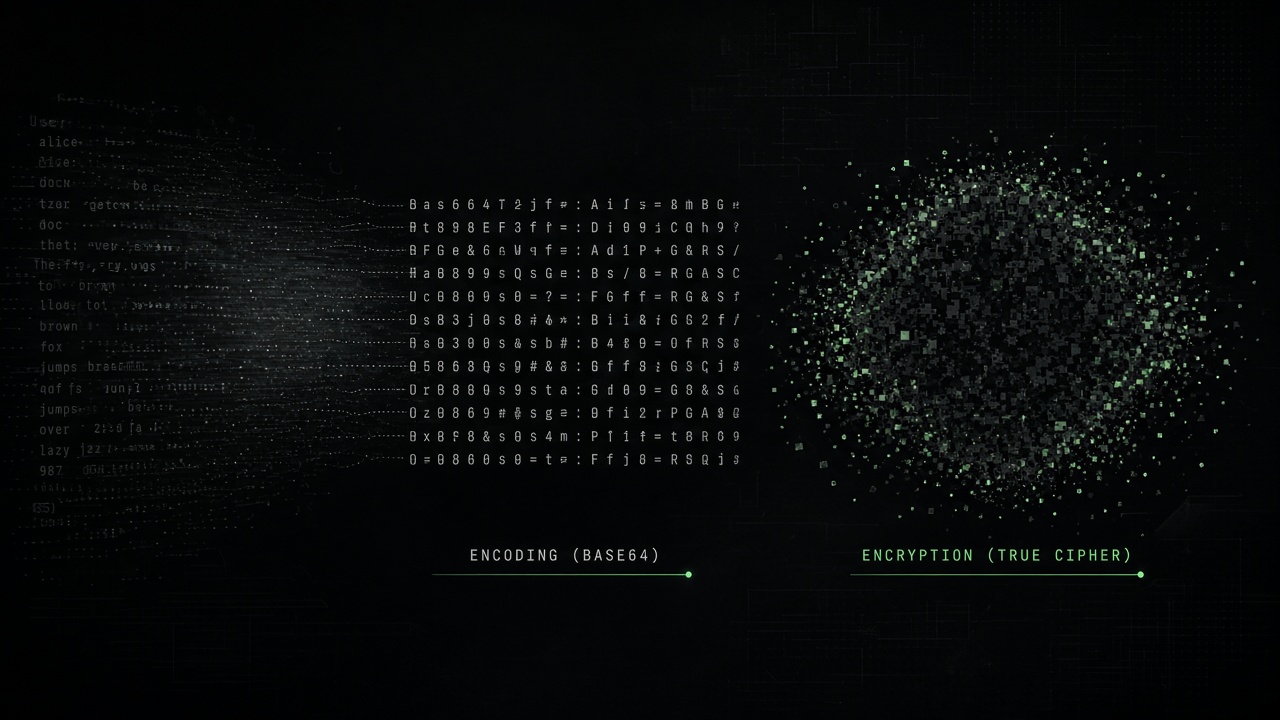
It is Base64 encrypted. Please award Critical.
Reply we actually send (short version)
Thanks for the report. Base64 is encoding, not encryption. Anyone can decode it in one step; there is no key. We will treat this as sensitive data stored client-side in recoverable form if the decoded content is real — that can still be a finding, but the severity comes from what was stored, not from “breaking Base64.”
Sticky note on the monitor
encoding  →  change of representation (reversible, no secret)
encryption → confidentiality under a key (hard without the key)
hashing   → one-way fingerprint (not reversible by design)
If your grandmother can reverse it with a website from 2009, it was not encryption.
Common “encrypted” sightings in bounty threads
1. eyJ… blobs
Often a JWT. Signed ≠ encrypted. The middle segment is readable Base64url JSON.
2. URL-encoded JSON
%7B%22role%22%3A%22admin%22%7D is not vault material. Decode the URL encoding and you are done.
3. Hex dumps of ASCII
70617373776f7264 → password. Still not crypto.
4. Double-wrapped candy
URL-encode(Base64(plain)). Looks scary; two peels and it cries.
5. Actual encryption
AES/GCM blobs, proper envelopes, key IDs, nonces. Different conversation. Ask for ciphertext structure, not vibes.
How we peel without theatre
Use a local chain so you do not paste secrets into random “decoder” sites. Codec Chain stacks URL / HTML / Base64 / Base64URL / hex (and friends) in your browser — default layer is Base64 decode because that is the usual first move. Peel encodings locally; do not confuse the output with “decrypted.”
Triage habit:
- Identify wrappers (Base64 charset?
%xx?\u00xx?) - Peel one layer at a time
- Stop when you hit JSON, credentials, or binary noise that needs a real crypto story
- Write the finding about impact (“credential in localStorage”) not the costume (“Base64”)
When encoding does matter in a report
Encoding bugs are still real — just different:
- double-encoding bypasses in WAFs / open redirects
- charset confusion in parsers
- “encrypt” buttons in apps that only Base64 before upload (privacy bug, marketing lie)
Call those out clearly. Just do not file them as “cryptographic break.”
Closing the ticket
| Researcher said | We translate to |
|---|---|
| Base64 encrypted password | Recoverable secret at rest in the client |
| Hidden admin JWT | Readable claims; check signature & authz separately |
| Obfuscated script | Encoding/minification; not a cipher |
Be kind. Many researchers are learning. Precision helps them level up — and keeps your program’s severity model intact.
Encoding hides nothing from an attacker who can read. Encryption hides something from an attacker who cannot get the key. Keep the words honest.