Myth
“Add a symbol and a number and you are secure.”
Reality
Attackers do not grade your password like a corporate policy form. They try guessable structure first, then brute force / cracking against whatever hash they stole. A short password with theatre (P@ssw0rd1!) is still a short password.
Myth
“Complexity rules beat length.”
Reality
Rough mental model for randomly chosen passwords:
[ \text{entropy bits} \approx \log_2(|charset|) \times length ]
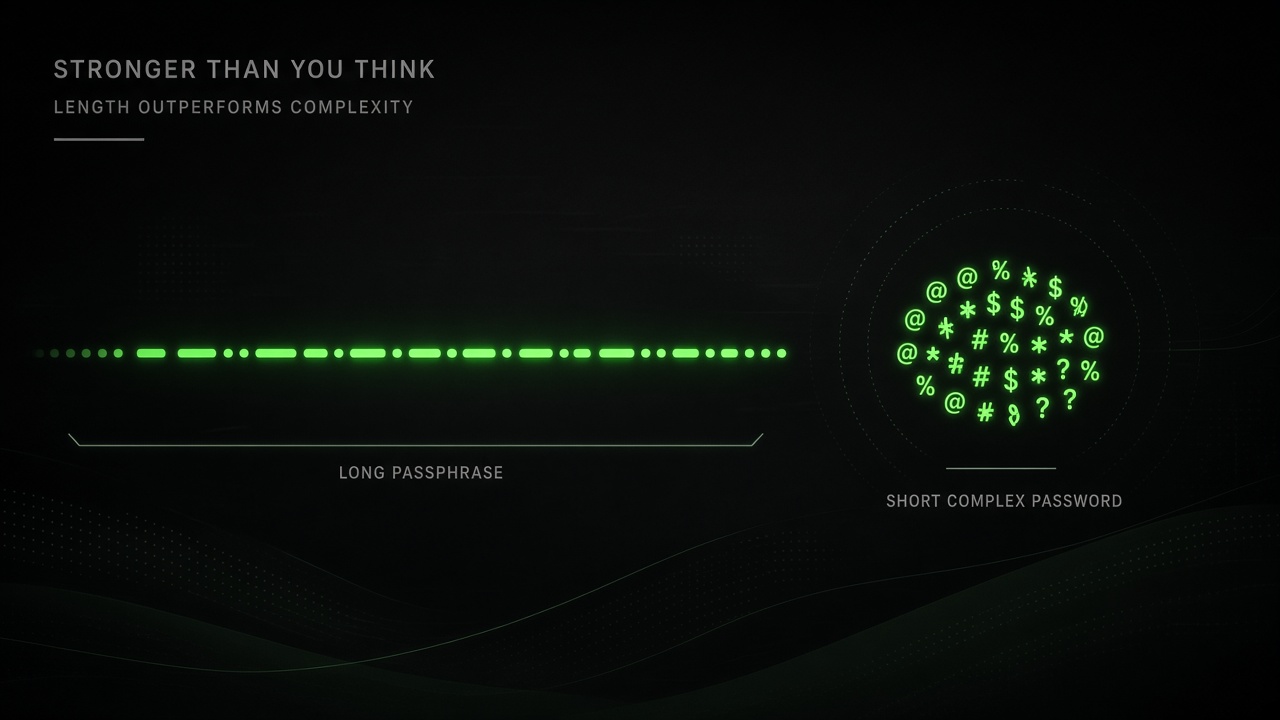
Doubling length helps more than sprinkling punctuation on an 8-character base. An 8-character password from a big alphabet can still be weaker than a 20-character password from a slightly smaller alphabet — especially once humans reuse patterns (Name + Year + !).
Length is not magic if the generator is predictable. Diceware / crypto RNG ≠ “keyboard smash that looks random.”
Myth
“Exclude 0OIl1 and you weakened the password.”
Reality
You traded a few bits of pool size for fewer support tickets and fewer mistypes. For human-entered secrets (Wi‑Fi on a TV remote, recovery codes read aloud, passwords typed on a phone), ambiguous glyphs are a reliability bug.
If the secret is copied, not typed, keep the full alphabet. If it is typed, excluding lookalikes is often the adult choice.
Myth
“Online generators are fine; HTTPS protects me.”
Reality
HTTPS protects the pipe. It does not answer:
- who logs the plaintext
- whether the page was compromised
- whether you will reuse that password elsewhere after it left your machine
Prefer local generation. The Password Generator on this site stays in your tab: crypto RNG, length slider, charset toggles, exclude 0OIl1, and a strength readout in bits.
A boring policy that works
- Unique password per important account (manager required)
- Long by default (16–20+ for random character passwords; more words for passphrases)
- Random, not clever
- Typed secrets: consider excluding ambiguous characters
- Copied secrets: maximize charset if you want
- Prefer passkeys / MFA so a single password is not the whole kingdom
One-line takeaway
Complexity theatre is what policies measure. Entropy and uniqueness are what attackers notice.